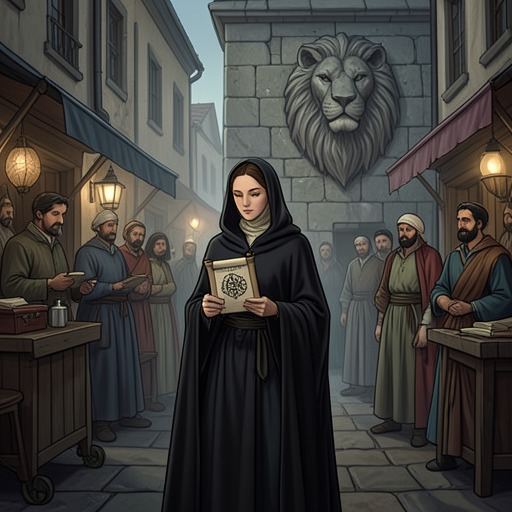
Ginevra's male disguise
The DecameronGinevra's male disguise is the means by which she survives an order for her murder, moves through a world that would otherwise sharply restrict her, and ultimately reveals the truth before the Soldan. As Sicurano da Finale, she passes from a lonely valley to a ship, a position in the Soldan's service, and the command of a merchant guard at Acre. The disguise conceals her identity for six years; when she casts it off, the woman believed dead stands before her husband and accuser as the living witness to their betrayal.
Flight and transformation
Bernabo Lomellini orders a servant to kill Ginevra after Ambrogiuolo of Piacenza falsely claims to have slept with her. In a deep, secluded valley, the servant draws his knife and tells her that her husband has commanded her death. Ginevra pleads for her life and offers him a way to obey the order without killing her: he can take her clothes, return to Bernabo, and report that he has slain her, while she leaves the country and never sends word back. The servant, moved to pity, accepts the exchange, gives her his worn doublet and hood, and leaves her the money she was carrying. He tells Bernabo that she is dead and has been devoured by wolves.
Ginevra remains alone until nightfall, then goes to a nearby village. With an old woman's help, she alters her clothing: she shortens the doublet, makes linen breeches from her shift, and cuts her hair. The changes are practical and cumulative, converting the clothes she has been given into a sailor's outfit and helping her pass as a man. She reaches the shore and finds the Catalan gentleman Senor Encararch, whose ship lies offshore. Presenting herself as a servant under the name Sicurano da Finale, she embarks with him; he supplies better clothes, and her capable service wins his favor.
A new identity across the sea
When Senor Encararch sails to Alexandria with merchandise and peregrine falcons for the Soldan, Sicurano goes with him. The Soldan, having received the falcons and observed Sicurano's conduct, asks Encararch to give the servant into his service. Sicurano's good behavior earns the Soldan's trust and affection just as it had earned Encararch's. The disguise thus becomes more than concealment: it gives Ginevra a durable public identity and access to positions of responsibility.
The Soldan later sends Sicurano to Acre as governor and captain of the guard for a great annual fair attended by Christian and Saracen merchants. By then Sicurano knows the language of the country. The appointment places Ginevra in authority over the safety of merchants and their goods, while her rounds bring her among Italians from Sicily, Pisa, Genoa, Venice, and elsewhere. The route from the valley to Alexandria and Acre makes the scale of her altered life concrete: a woman left for dead has crossed borders and entered the service of a ruler who knows her only by her assumed name.
The disguise becomes evidence
At the fair, Sicurano recognizes a purse and girdle among goods displayed by Venetian merchants. They had belonged to Ginevra. She asks about them without revealing her reaction, and Ambrogiuolo steps forward to claim them. He explains that, according to his story, Ginevra gave him the objects after he had slept with her. Sicurano keeps a steady appearance and invites him to explain how he acquired them. The disguise allows Ginevra to hear the false account from its source while holding the authority to pursue the matter without yet disclosing who she is.
Sicurano arranges for Ambrogiuolo and Bernabo to appear before the Soldan. Bernabo admits that, believing the accusation and consumed by anger, he ordered a servant to kill his wife; Ambrogiuolo's claim and the supposed report of her death have hidden the truth from him. Sicurano then kneels before the Soldan, abandons the masculine voice and manner, and identifies herself as Ginevra. She opens the front of her clothes to reveal her breast, making the identity concealed by the disguise unmistakable. The proof is not merely verbal: the person whom both men failed to recognize is present to confront them.
Exposure and return
The Soldan, who had believed Sicurano to be a man, first doubts what he sees, then praises Ginevra's conduct and constancy. At her request, he pardons Bernabo, who recognizes her, falls at her feet, and begs forgiveness. Ginevra grants it and embraces him. The contrast is sharp: Bernabo had trusted a stranger's lie over his wife's truth and ordered her death, yet she chooses reconciliation when the Soldan gives her the power to demand punishment.
Ambrogiuolo receives the opposite judgment. The Soldan orders him bound to a stake, smeared with honey, and exposed in a high place to the sun until he falls of himself. His property is given to Ginevra, and the Soldan also grants her jewels, gold and silver vessels, and money worth more than ten thousand doubloons. After a banquet honoring both Ginevra and Bernabo, the Soldan equips a ship for their return to Genoa. Ginevra's male disguise ends with public recognition, but its consequences remain: it has kept her alive, enabled her to become an official trusted by the Soldan, and brought her back from presumed death with her name and reputation restored.